Tutorial
An Agent Without Evals Is a Vibe With a Deploy Button (Part 7)
The demo sounds sharper. Production quietly gets worse. Part 7 — the series finale: deterministic checks, model-graded scorers, CI gates, and live sampling so 'it seems better' becomes '0.86, up from 0.71'.
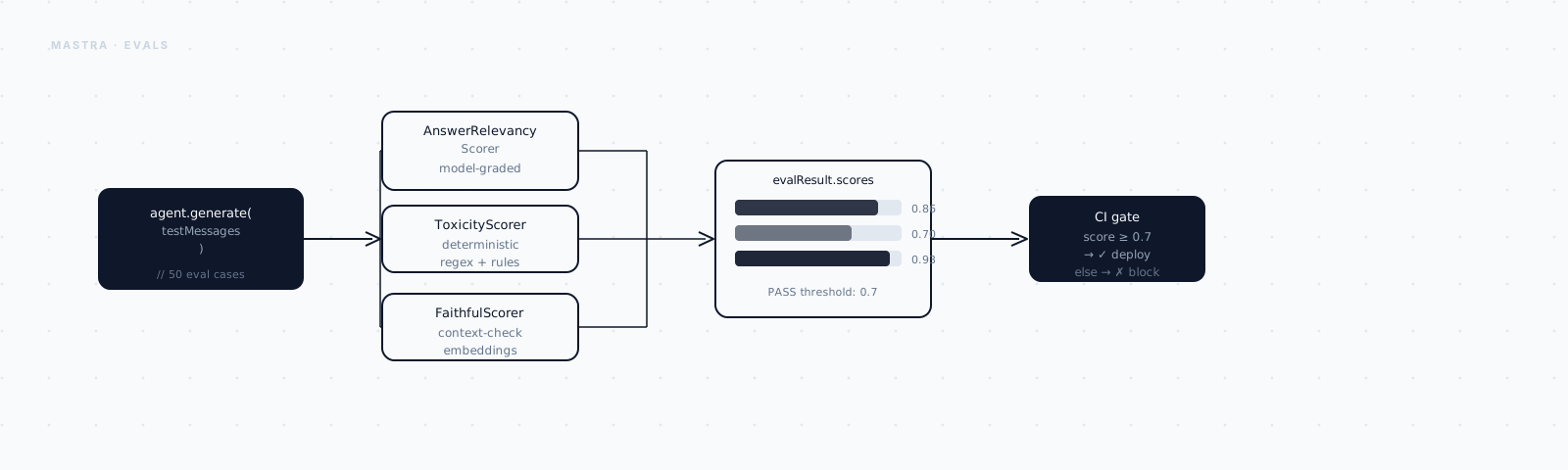
You tweak the prompt. The demo runs great — the answer sounds sharper, more confident, more on-brand. You ship it.
Three days later, someone on support forwards a screenshot. The agent quoted a refund policy that doesn't exist.
Nothing crashed. No error fired. Nothing showed up in a log. It just quietly got worse, and the only reason anyone noticed was a user complaining.
Over six parts of this series you built an agent, wrapped it in workflows and a harness, streamed it, grounded it in RAG, and made it survive crashes and run on a schedule. Every one of those parts made the agent capable of something new.
None of them answered the question that decides whether any of it is safe to put in front of real users:
Is it actually good — and how would you know if a change made it worse?
"It seems better" is not an answer you can ship on. Every prompt edit becomes a coin flip you can't see land, because the vibe replaces the metric, and vibes drift. This part replaces the vibe with numbers.
Two kinds of "is it good?"
Agent quality splits into two different questions, and each one needs its own tool.
The first kind is factual. Did it call search-docs? Did it avoid tool errors?
Did it call tools in the right order? Every one of those has a plain yes-or-no
answer. You don't need a model's judgment for that — you need code. Fast, free,
and it never has an off day. That's a check.
The second kind is qualitative. Is the answer actually relevant to what was asked? Is it faithful to the retrieved passages, or did it quietly drift away from them? Is it toxic? None of those collapse into a simple equality check. They need judgment, so a model reads the output and hands back a score. That's a scorer.
Reach for a scorer only when a check genuinely can't answer the question. A
model-graded eval is slower, costs tokens, and has variance of its own — don't
spend it on something === could decide for free.
Checks are where every eval suite should start. Let's build one.
Checks — deterministic, and where you start
Say you want to guarantee the RAG agent from Part 5 always looks something up before answering — the "never guess" rule from that part, enforced.
That's a check: did the run call search-docs?
import { runEvals } from "@mastra/evals";
import { checks } from "@mastra/evals/checks";
import { supportAgent } from "../mastra/agents";

const result = await runEvals({
  target: supportAgent,
  data: [
    { input: "What's our refund window for annual plans?" },
    { input: "How do I cancel a monthly plan?" },
  ],
  gates: [
    checks.calledTool("search-docs"),  // must have retrieved
    checks.noToolErrors(),             // and nothing threw
  ],
});

console.log(result.verdict); // "passed" | "scored" | "failed"✓ calledTool(search-docs) 2/2
✓ noToolErrors 2/2
verdict: passedThe checks namespace covers the common factual questions out of the box:
calledTool(name)— the run used that tool.noToolErrors()— no tool threw.includes(text)— the output contains an expected string.toolOrder([...])— tools fired in the sequence you expect (retrieve before answer, not after).
Because they're deterministic, checks belong in gates — they can hard-fail a
run. That's what makes them CI-safe: no flakiness, no token cost, a clean
pass/fail.
Checks get you a long way. But some questions never reduce to a yes-or-no, no matter how you phrase them.
Scorers — for the fuzzy questions
Now for the questions code can't answer.
Was the answer actually relevant to what was asked? Was it faithful to the retrieved passages, or did it wander? Mastra ships prebuilt, model-graded scorers for exactly these two questions.
import { runEvals } from "@mastra/evals";
import {
  createAnswerRelevancyScorer,
  createToxicityScorer,
} from "@mastra/evals/scorers/prebuilt";
import { openai } from "@ai-sdk/openai";

const judge = openai("gpt-4o");

const result = await runEvals({
  target: supportAgent,
  data: [
    { input: "What's our refund window for annual plans?" },
    { input: "Can I get a refund after 60 days?" },
  ],
  scorers: [
    createAnswerRelevancyScorer({ model: judge }),
    createToxicityScorer({ model: judge }),
  ],
});answer-relevancy 0.91 avg
toxicity 0.00 avg
verdict: scoredNotice the verdict is scored, not passed.
A scorer produces a number, and a number on its own doesn't fail a build. To make it a gate, put a threshold on it: relevancy must average at least 0.8. Now a prompt change that quietly tanks relevancy to 0.62 fails CI instead of shipping.
Combine both in one run: gates for the deterministic checks that must pass, and
scorers for the quality numbers you threshold. The verdict reflects both — it
only reports passed when every gate held and every thresholded scorer cleared
its bar.
Numbers on a screen are good. Numbers that block a bad deploy before it ships are better.
Wiring it into CI
The entire payoff of evals is that they run automatically, on every change, without anyone remembering to click a button.
A runEvals call is just code. It drops straight into whatever test runner you
already use — no special harness required.
import { runEvals } from "@mastra/evals";
import { checks } from "@mastra/evals/checks";
import { createAnswerRelevancyScorer } from "@mastra/evals/scorers/prebuilt";
import { supportAgent } from "../mastra/agents";
import { openai } from "@ai-sdk/openai";

const result = await runEvals({
  target: supportAgent,
  data: goldenQuestions,               // your curated question set, in version control
  gates: [checks.calledTool("search-docs"), checks.noToolErrors()],
  scorers: [createAnswerRelevancyScorer({ model: openai("gpt-4o") })],
});

if (result.verdict === "failed") {
  process.exit(1); // fail the build — a regression doesn't merge
}- name: Run agent evals
run: pnpm tsx evals/agent.eval.ts
env:
OPENAI_API_KEY: ${{ secrets.OPENAI_API_KEY }}That goldenQuestions set is the asset that compounds.
Every time the agent gets something wrong in production, you add that case to the set. The eval suite grows into a memory of every mistake the agent has ever made — and every one it's now provably guarded against.
CI proves the agent is good on questions you thought of. It has nothing to say about the ones you didn't.
Evals in production, not just CI
Production is where the agent meets the questions no one wrote into the golden set.
So Mastra lets you attach scorers to a live agent and sample real traffic — score a fraction of actual runs, no golden set required:
export const supportAgent = new Agent({
  name: "support",
  instructions: "...",
  model: openai("gpt-4o"),
  tools: { searchDocs },
  scorers: {
    relevancy: {
      scorer: createAnswerRelevancyScorer({ model: openai("gpt-4o") }),
      sampling: { type: "ratio", rate: 0.1 }, // grade 10% of live runs
    },
  },
});
Now 10% of real conversations get a relevancy score, quietly, in the background.
The sampling rate is the knob. Crank it up for a risky launch week. Dial it down once the numbers get boring.
This is how you catch the slow drift a fixed CI set never will. The moment production relevancy starts sliding, you see it in the data — not in a support escalation.
What "good" actually means now
Go back to Part 1 for a second. The agent was a loop that called a model and handed back an answer. That was the whole system, and the only way to know if it was any good was to read the transcript yourself and shrug.
Six parts later, it composes into workflows. It runs inside a harness. It streams. It's grounded in your own docs. It survives a crash and comes back to finish the job. Every one of those was a genuine improvement to what the agent could do — and not one of them, on its own, told you whether the agent was actually good.
This part is what closes that loop:
- Checks — deterministic, gating, free. Start here for anything with a definite answer.
- Scorers — model-graded numbers for relevancy, faithfulness, toxicity. Threshold them to make them gate.
runEvalsin CI — a regression fails the build instead of reaching users.- Golden set — a growing, version-controlled memory of every past mistake.
- Live sampling — score real traffic to catch the drift CI can't.
Put those together and "it seems better" stops being an opinion. It becomes a number, checked against yesterday's number, gating a build. That's the whole difference between shipping on vibes and shipping on evidence.
That's the arc, start to finish: build it, orchestrate it, host it, stream it, ground it, keep it alive — and now, prove it's good and keep it that way. An agent you can put numbers on is an agent you can actually ship.
Thanks for reading the series. Every code sample here runs on public Mastra and AI SDK APIs — go build something and put an eval on it.