Essay
I Stopped Hand-Rolling the Agent Loop — AI SDK v7 Features Worth Shipping
Every agent project had the same skeleton at the top: call the model, run tools, loop, pray you got the stop condition right. v7 moves that — plus approvals, structured output, and telemetry — into the SDK. Here's what I reached for the week it landed.
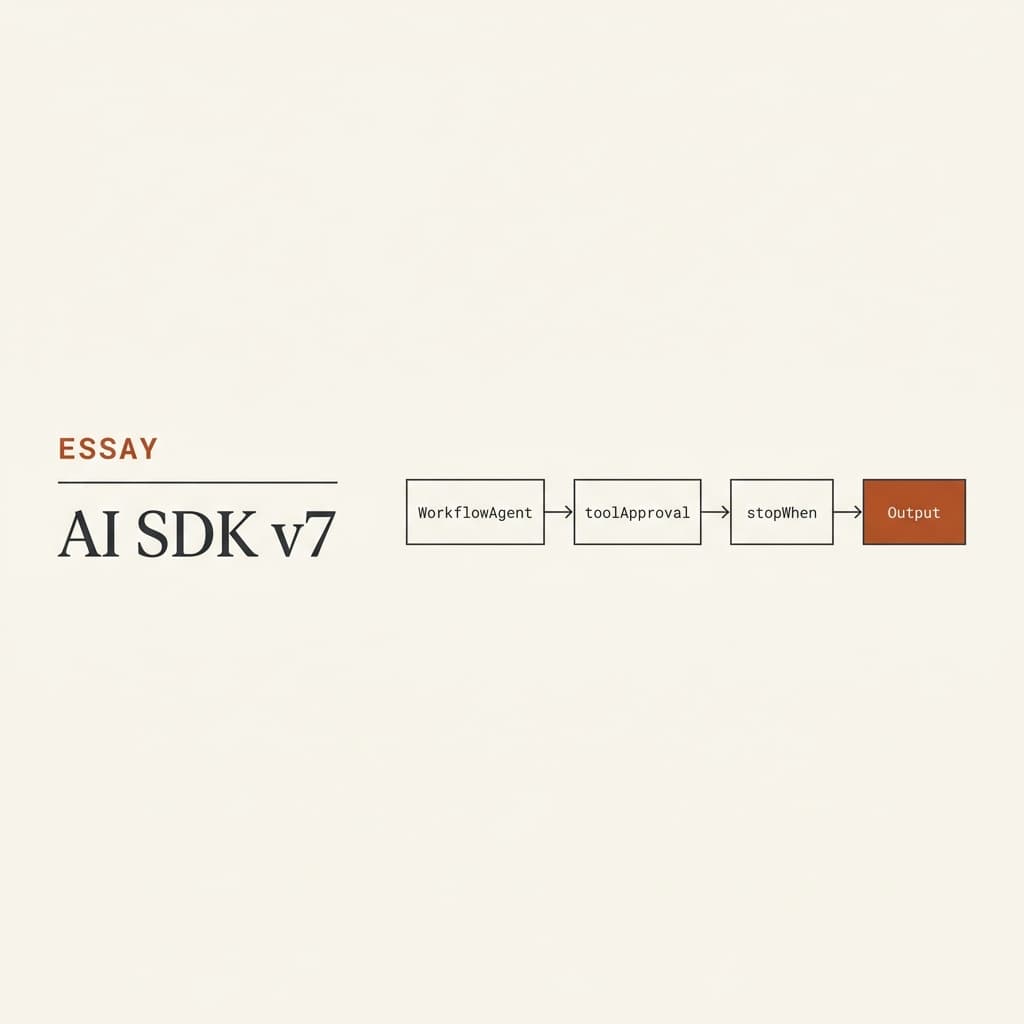
I've shipped enough agent code on the AI SDK to have a list of things I rebuilt by hand every project: the "keep calling the model until it stops asking for tools" loop, a way to pause for human approval before a destructive tool runs, telemetry that didn't feel bolted on. v7 ate most of that list. It's ESM-only and wants Node 22+, which annoyed me for exactly one afternoon and then stopped mattering.
This isn't a changelog. It's the handful of features that changed how I write agents, in rough order of how much they changed it.
Everything here is v7 (7.0.x) and public. Where a name changed from v6 I've called it out, because the renames are the thing most likely to trip you up in a migration.
1. WorkflowAgent — the loop is finally not my problem
For two years every agent I wrote had the same skeleton hand-rolled at the top: call the model, check if it wants a tool, run the tool, feed the result back, loop, and bail out before it runs forever. Everyone wrote that loop. Everyone got the stop condition subtly wrong at least once.
v7's WorkflowAgent (from @ai-sdk/workflow) turns that control flow into
declared steps, with 'use step' and 'use workflow' directives marking the
boundaries the SDK checkpoints and orchestrates:
"use workflow";

import { WorkflowAgent } from "@ai-sdk/workflow";

// Each 'use step' is a durable boundary the runtime can retry and resume.
async function gather(topic: string) {
  "use step";
  // ...retrieve sources...
}

async function synthesize(sources: string[]) {
  "use step";
  // ...write the brief...
}
The win isn't fewer lines — it's that the boundaries become real to the runtime. It knows where a step starts and ends, so it can retry one step without replaying the whole run. The loop I used to get wrong is now the SDK's job.
2. Tool approval — the feature I'd hacked around in every prod app
The single scariest thing about agents is the tool that does something
irreversible: sends the email, deletes the row, charges the card. In v6 I gated
those with my own middleware every time. v7 has toolApproval as a first-class
concept — the run suspends before the tool executes and waits for a decision.
const deleteRecord = tool({
  description: "Permanently delete a customer record.",
  inputSchema: z.object({ id: z.string() }),
  needsApproval: true, // the run pauses here until a human responds
  execute: async ({ id }) => db.records.delete(id),
});
On the client, useChat gained addToolApprovalResponse to answer the prompt:
const { addToolApprovalResponse } = useChat();

// When the UI shows "Agent wants to delete record #841 — allow?"
addToolApprovalResponse({ id: approvalId, approved: true });
This pairs perfectly with the durable/suspend model — the agent can wait for the click for as long as it takes. I've deleted a genuinely embarrassing amount of custom approval plumbing because of this one.
Default needsApproval: true on anything that writes, sends, or spends. The
approval prompt is cheap; the 2am "why did the agent email all our customers"
incident is not.
3. Unified reasoning — one dial across every model
v6 had you configuring reasoning/thinking differently per provider — a provider-specific option here, a different one there. v7 collapses it to one dial that means the same thing everywhere:
const result = await generateText({
  model,
  reasoning: "high", // 'none' | 'low' | 'medium' | 'high' | 'xhigh'
  prompt: "Prove that √2 is irrational.",
});
The value is portability. I set reasoning: 'high' for a hard planning step and
'none' for a cheap classification, and I can swap the underlying model without
rewriting how I ask it to think. Small feature, disproportionate relief.
4. stopWhen — say when out loud
Bailing out of the agent loop used to be a magic number buried in config. v7's
stopWhen makes the stop condition a readable expression, and composes several:
const result = await generateText({
  model,
  tools,
  stopWhen: [
    isStepCount(10),        // never more than 10 steps
    hasToolCall("submit"),  // stop the moment it submits
    isLoopFinished(),       // or when the loop naturally ends
  ],
});
isStepCount is what v6 called stepCountIs — this is one of the renames to
watch. But reading hasToolCall("submit") in a diff tells you exactly when the
agent is meant to stop, which a bare 10 never did.
5. Structured output that isn't experimental_ anymore
Output graduated. Output.object, Output.array, and Output.choice give you
typed, validated output as a supported API rather than the experimental_output
I'd been shipping on nervously:
const { output } = await generateText({
  model,
  output: Output.object({
    schema: z.object({ sentiment: z.enum(["pos", "neg"]), score: z.number() }),
  }),
  prompt: review,
});
// output is typed and validated — no JSON.parse, no try/catch around a hope
Output.choice in particular is a clean way to force the model to pick from a
fixed set — classification without the prompt-engineering gymnastics.
6. Telemetry that isn't an afterthought
I want traces of what the agent did — which tools, how many tokens, where the
time went — without threading a logger through every call. v7's
registerTelemetry (from ai, with @ai-sdk/otel) wires OpenTelemetry once, at
the top:
import { registerTelemetry } from "ai";
import { otelExporter } from "@ai-sdk/otel";

registerTelemetry({ exporter: otelExporter() });
// every generateText / streamText / tool call now emits spans
Then every run shows up in whatever OTel backend you already run. The reason this matters: the first production agent incident you debug without traces is the last one you'll want to.
The renames, in one place
If you're migrating from v6, these are the ones that'll bite. Nothing conceptual changed — the names got clearer:
Why this release actually matters
Squint at the list and there's one theme: the hard, error-prone parts of building an agent moved from my code into the SDK. The loop, the stop condition, the approval gate, the telemetry — the stuff everyone rebuilt and someone always got wrong is now a supported API with a name.
That's the release I want from an agent framework. Not more surface area — less
of my surface area for bugs to hide in. If you're still on v6, the ESM +
Node 22 jump is the whole tax, and WorkflowAgent plus toolApproval alone are
worth paying it.
If you want to see these applied end-to-end, my Mastra series builds on the same AI SDK primitives — Mastra sits a layer above and leans on exactly these features.