Tutorial
The State Machine You Were About to Write Already Exists — LiveKit Voice Agents
Phone agents need dates, room types, and callback numbers. The instinct is a CallState dataclass and next_question(). LiveKit Agents already solved that with AgentTask and TaskGroup — here's the hotel receptionist that shows how.
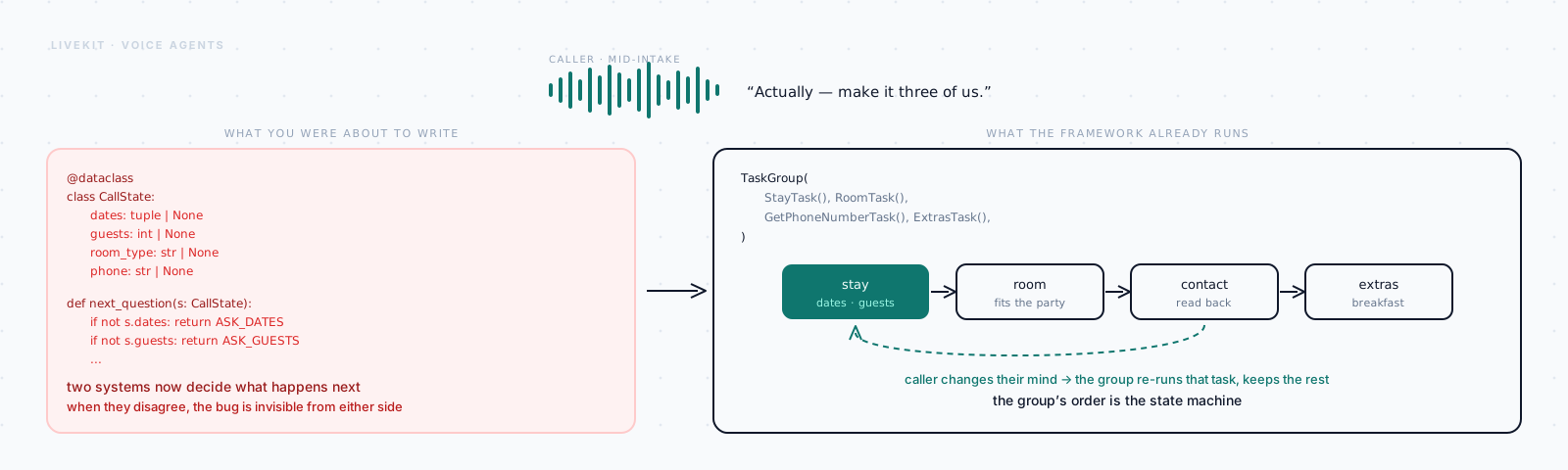
You're building a phone agent. It needs check-in and check-out dates, a room
type, a phone number, maybe breakfast. So you sketch a CallState dataclass,
track which fields are filled, and write a next_question() that returns the
next slot to ask for.
That instinct feels rigorous. It's also the mistake.
You end up with two systems deciding what happens next — yours and whatever the voice framework already runs — and when they disagree, the bug is invisible from either side. LiveKit Agents for Python gives you a different shape: one agent for the call, tasks for multi-turn collection, and a TaskGroup for ordered intake with backtracking. The group's order is the state machine.
This walkthrough follows a small repo I published so you can read the code, not just the ideas: livekit-hotel-receptionist. livekit-agents 1.6.9, Python 3.12, uv. Everything below is copied from that project.
What we're building
A fictional hotel answers the phone, runs an intake conversation, writes a booking, and confirms. The interesting bit is regression: the caller can change their mind mid-flow.
"Hi, I'd like a room for the 14th to the 16th, two of us."
     → dates and guests
     → room that fits two people
     → callback number, read back
     → breakfast and late checkout
     → booked, then confirmed

"Actually, make it the 15th."     ← works, at any point in the group
Read tasks.py → receptionist.py → hotel.py → agent.py. The hotel
backend never imports LiveKit.
Why voice is not chat with a microphone
A text agent is mostly LLM latency. A voice agent is a pipeline, and every stage adds time the caller feels in their ear.
You don't get to hide behind "the model was slow." If STT endpointing fires early, you interrupt the caller. If TTS starts before you've finished thinking, you sound eager and wrong. If your booking write is a tool the model can call whenever it feels like it, you can confirm a reservation that never happened.
The numbers below are illustrative, not benchmarks — they show why each stage matters in a single turn budget:
Voice forces you to be explicit about when a turn ends. That's turn detection, not prompt engineering.
Turn detection is the hard problem
Most sample agents use a silence timer: "500 ms quiet means they're done." That works until someone says a phone number, an address, or anything with deliberate pauses.
LiveKit's current default is the audio turn detector —
inference.TurnDetector()
— built into the SDK since 1.6.1. It reads words and prosody, not just gaps.
Endpointing, end-of-utterance (EOU), barge-in, and backchannel handling all
live in that layer — see the turn detector docs
for vocabulary. The hotel demo wires this through TurnHandlingOptions in
agent.py rather
than scattered kwargs — turn detector, dynamic endpointing, adaptive interruption:
turn_handling = TurnHandlingOptions(
    turn_detection=inference.TurnDetector(),
    endpointing={"mode": "dynamic"},
    interruption={
        "mode": "adaptive",
        "min_duration": 0.5,
        "min_words": 0,
    },
    preemptive_generation={
        "preemptive_tts": False,
    },
)
Leave the old VAD-era min_delay: 0.5, max_delay: 3.0 numbers out when the
audio detector is active. The session already tightens defaults; copying blog
posts makes the agent slower for no gain.
Start with one agent and tools
The workflows docs are blunt: start with one agent and a few tools. Split only on a concrete limitation — instruction bloat, conflicting tool access, multi-turn collection, or backtracking. "We might need handoffs later" is not on the list.
The receptionist is that single agent: hotel-wide instructions, an end-call tool,
and the intake group inside on_enter:
class Receptionist(Agent):
    def __init__(self) -> None:
        end_call_tool = EndCallTool(
            extra_description="End the call after the guest is finished or says goodbye.",
        )
        super().__init__(
            instructions=(
                f"You are the voice receptionist for {HOTEL_NAME}. "
                "Help with room bookings, take messages, and end calls politely."
            ),
            tools=end_call_tool.tools,
        )
Rule of thumb I'll repeat because it saves design arguments:
If the model needs to ask a follow-up question, it's a task. If it's one call with arguments, it's a tool.
take_message is a tool. Collecting check-in, check-out, and guest count — with
corrections along the way — is not.
Where one agent breaks: AgentTask
An AgentTask is a focused
sub-conversation that returns a typed result. The framework handles "what do I
still need?" inside the task — you expose tools that call self.complete(...)
when the slot is filled.
StayTask is the smallest example in the repo:
class StayTask(AgentTask[Stay]):
    def __init__(self, chat_ctx=None) -> None:
        super().__init__(
            instructions=stay_task_instructions(),
            chat_ctx=chat_ctx,
        )

    async def on_enter(self) -> None:
        await self.session.generate_reply(
            instructions="Ask for check-in date, check-out date, and number of guests."
        )

    @function_tool()
    async def record_stay(
        self,
        context: RunContext,
        check_in: str,
        check_out: str,
        guests: int,
    ) -> None:
        """Record check-in, check-out (YYYY-MM-DD), and guest count."""
        if guests < 1:
            raise ToolError("Guest count must be at least 1.")
        self.complete(Stay(check_in=check_in, check_out=check_out, guests=guests))
GetPhoneNumberTask is a prebuilt task
with confirmation built in.
TaskGroup: order, context, regression
TaskGroup runs tasks in
sequence, shares chat context, and lets the caller jump back to an earlier step
when they change an answer. That's the feature you'd otherwise encode in
CallState.
The real add() calls from receptionist.py:
intake = TaskGroup(
    chat_ctx=chat_ctx,
    on_task_completed=on_task_completed,
)
intake.add(
    lambda: StayTask(chat_ctx=chat_ctx),
    id="stay",
    description="Collect check-in, check-out, and guest count",
)
intake.add(
    lambda: RoomTask(chat_ctx=chat_ctx, guests=stay_guests),
    id="room",
    description="Choose a room type from the catalog",
)
intake.add(
    lambda: GetPhoneNumberTask(
        chat_ctx=chat_ctx,
        extra_instructions=(
            f"Collect a callback number for the {HOTEL_NAME} reservation."
        ),
        require_confirmation=True,
    ),
    id="contact",
    description="Collect and confirm phone number",
)
intake.add(
    lambda: ExtrasTask(chat_ctx=chat_ctx),
    id="extras",
    description="Breakfast, late checkout, and notes",
)

try:
    results = await intake
except NoAvailability:
    await self.session.generate_reply(instructions=waitlist_instructions())
    return
The description on each add() is for the model when the caller regresses —
not a label for you.
TaskGroup is marked experimental upstream. The ideas are stable; the API
may shift. Check the tasks docs
before you bet a production roadmap on the exact import path.
Two mechanics that look like ceremony
Factory lambdas run when the task starts, not when you register it:
intake.add(lambda: RoomTask(chat_ctx=chat_ctx, guests=stay_guests), id="room", ...)stay_guests is updated in on_task_completed when "stay" finishes. If you
constructed RoomTask eagerly at the top of on_enter, you'd freeze
guests=1 forever. The lambda is how later tasks read values earlier tasks
produced — and how a task gets rebuilt cleanly when the caller regresses.
Early exit is an exception, not session.shutdown() inside the callback.
async def on_task_completed(event: TaskCompletedEvent) -> None:
    nonlocal stay_guests
    if event.task_id == "stay":
        stay = event.result
        stay_guests = stay.guests
        if not any_room_available(stay.check_in, stay.check_out):
            raise NoAvailability()
on_task_completed runs while the group is still iterating. Calling
session.shutdown() there raises RuntimeError because the stack isn't done.
Raise a custom exception, catch it where you await intake, and handle the
branch in normal async code — as with NoAvailability above.
Cancellation can surface as ToolError; the intake test uses suppress(ToolError).
Don't make the write a tool
This is the opinionated bit, and it's the strongest idea in the repo.
book_room is a plain function in hotel.py, called after the group
returns:
confirmation = book_room(
    check_in=stay.check_in,
    check_out=stay.check_out,
    room_type=room.room_type,
    guests=stay.guests,
    phone_number=contact.phone_number,
    breakfast=extras.breakfast,
    late_checkout=extras.late_checkout,
    notes=extras.notes,
)

room_name = ROOM_CATALOG[room.room_type].display_name
await self.session.generate_reply(
    instructions=booking_confirmation_instructions(confirmation, room_name),
)
If booking were a @function_tool, the model would choose when to call it.
It can say "you're all booked" before the write, or skip the write and say it
anyway. Prompting "never confirm unless the tool succeeded" does not fix that
reliably — it's the most damaging failure mode in a reservation agent.
As plain code, confirmation is the next statement after a successful write. The failure mode is designed out, not argued against in the system prompt.
Tools are for actions the model should decide to take. Consequences of a completed flow are just code.
The realism layer
Keyterms + keyterm_detection — biggest STT accuracy lever; distinctive
names break bookings when transcribed wrong:
keyterms = [HOTEL_NAME, "Harborview", "suite", "deluxe", "standard"]
keyterms.extend(room_type_ids())
# ...
stt_context_options=STTContextOptions(
    keyterms=keyterms,
    keyterm_detection={"enabled": True},
),
See keyterms in the docs.
BVCTelephony() for SIP, not BVC() from web samples. BackgroundAudioPlayer for ambience and a
thinking sound. min_consecutive_speech_delay around 0.2–0.4 so say() and
generate_reply() don't stack with no breath. user_away_timeout plus
user_state_changed to end abandoned calls. Fixed copy (the greeting) uses
session.say(), not generate_reply().
Three deprecated patterns still in sample code
Copy-paste from older posts will land you here:
UsageCollector/UsageSummary→ usesession.usage. Each entry insession.usage.model_usagehas.providerand.model:
async def log_usage() -> None:
    for usage in session.usage.model_usage:
        logger.info("%s/%s: %s", usage.provider, usage.model, usage)

ctx.add_shutdown_callback(log_usage)-
Session-level
metrics_collected→ prefersession_usage_updatedandChatMessage.metricsfor per-turn latency. Per-pluginmetrics_collectedis not deprecated — only the session-level event. -
Text turn detector
MultilingualModelandlivekit-agents[turn-detector]→ the audioinference.TurnDetector()needs no extra and replaces the text model slated for removal in 2.0. The extra pulls a large deprecated weights package you almost certainly don't want.
Testing, and a flaky test worth learning from
After session.start(), await asyncio.sleep(0.5) before the first
session.run() — TaskGroup briefly clears the session LLM during transitions.
Pass userdata into AgentSession(...) or get ValueError: AgentSession userdata is not set. Don't assert on greeting output from on_enter; it's outside the
first RunResult.
Now the flaky one. test_intake_raises_no_availability_for_blocked_dates
asserted contains_function_call(name="record_stay") after a single
session.run(). It passed most of the time and failed roughly one run in five,
with AssertionError: No FunctionCallEvent satisfying criteria found.
The cause wasn't a race. Given the dates, the model usually called record_stay
straight away — but sometimes read them back first ("To confirm, check-in is
2026-12-24… is that correct?") and called the tool on the next turn.
contains_function_call() searches the whole response, but only of one
session.run().
The fix is to drive the conversation until the outcome appears:
await session.start(_IntakeRunner())
await asyncio.sleep(0.5)
replies = ["December 24 2026 to December 26 2026, two guests.", "Yes, that's correct."]
for reply in replies:
    if hotel_userdata.messages:
        break
    with suppress(ToolError):
        await session.run(user_input=reply)
    await asyncio.sleep(0.5)

assert hotel_userdata.messages == ["waitlist"]
Assert on outcomes, not conversational choreography. Anything that assumes the model needs exactly N turns is a test that fails on Fridays.
Run uv run -m livekit.agents download-files once to fetch weights for
locally-run plugins (Silero VAD here). uv run agent.py download-files still
works but is deprecated as of 1.5.10 — use the module form in scripts and
CI.
How to read the repo
Clone livekit-hotel-receptionist,
uv sync, download files, copy .env.example, then uv run agent.py console
to talk on your mic.
I'd read in this order: tasks.py (what a task is), receptionist.py (the
group and booking boundary), hotel.py (fake backend), agent.py (session
wiring), tests/ (especially test_intake_flow.py). docs/ARCHITECTURE.md and
docs/NOTES.md go deeper on lifecycle and the choices this article compresses.
You don't need to hand-roll CallState. You need to know when the framework's
task group is doing the job your notebook sketch was trying to do — and when to
keep writes out of the model's hands. That's the whole game.